FlagDecker effect card builds from boards we would actually play
You get two effect slots and a board of five flags. After a few thousand bot matches, our view is simple: pick the board shape first and let the pair follow it. The same five flags can score 74 bare or 138 with the right two cards.
Climb from Edict to Imperium on one chain for 112
The Central African chain looks modest at first: Cameroon, Gabon, Equatorial Guinea, Congo and Central African Rep. Cameroon is base 4; the others are base 5. Seven links run through them. Start it whenever you see it, because chains are forgiving. (The master guide covers why this corner of Africa scores so well.) You do not need to guess which chain cards will show up. You just build the shape and plug in whatever you find.
Edict is a tier 1 card, so it can turn up from round 1. It adds 6 to any chain of 3 or more cards, which makes it a fine first buy and a poor last one. Iron Crown comes with tier 2 from round 3 and adds 2 per chain card. On this five-card chain the two together are worth 16, so the board sits at 90.
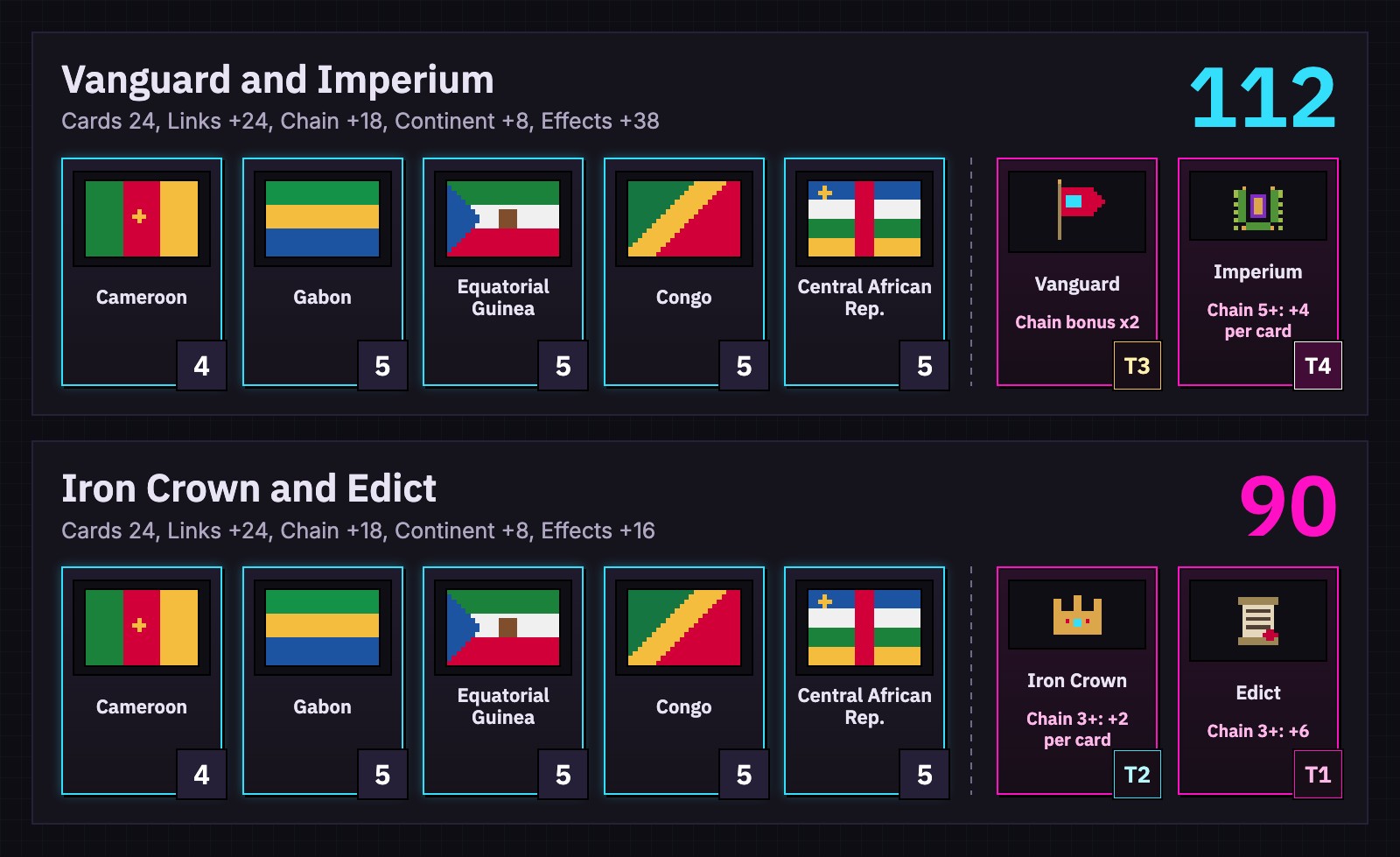
Round 6 is when Vanguard can show up, and this is the moment the chain wakes up. Vanguard doubles the chain bonus, so a five-card chain goes from +18 to +36. Sell Iron Crown for it without a second thought.
Imperium is the last piece and the slowest, because tier 4 only opens in round 9. It pays +4 per card on a chain of 5 or more, so 20 here, and it takes Edict's slot. Vanguard and Imperium together put the board at 112, against 90 for the Iron Crown and Edict pair it replaced. We like this route because every step is a straight swap on the same five cards.
Pick a board with nine links and Grand Alliance pays 45
The Great Lakes of East Africa are more work than Central Africa. Burundi, Tanzania, Uganda, Rwanda and DR Congo start at 63 points bare, which is 11 points behind the Central African chain. But they have 9 links instead of 7. This matters enormously when you pick Grand Alliance.
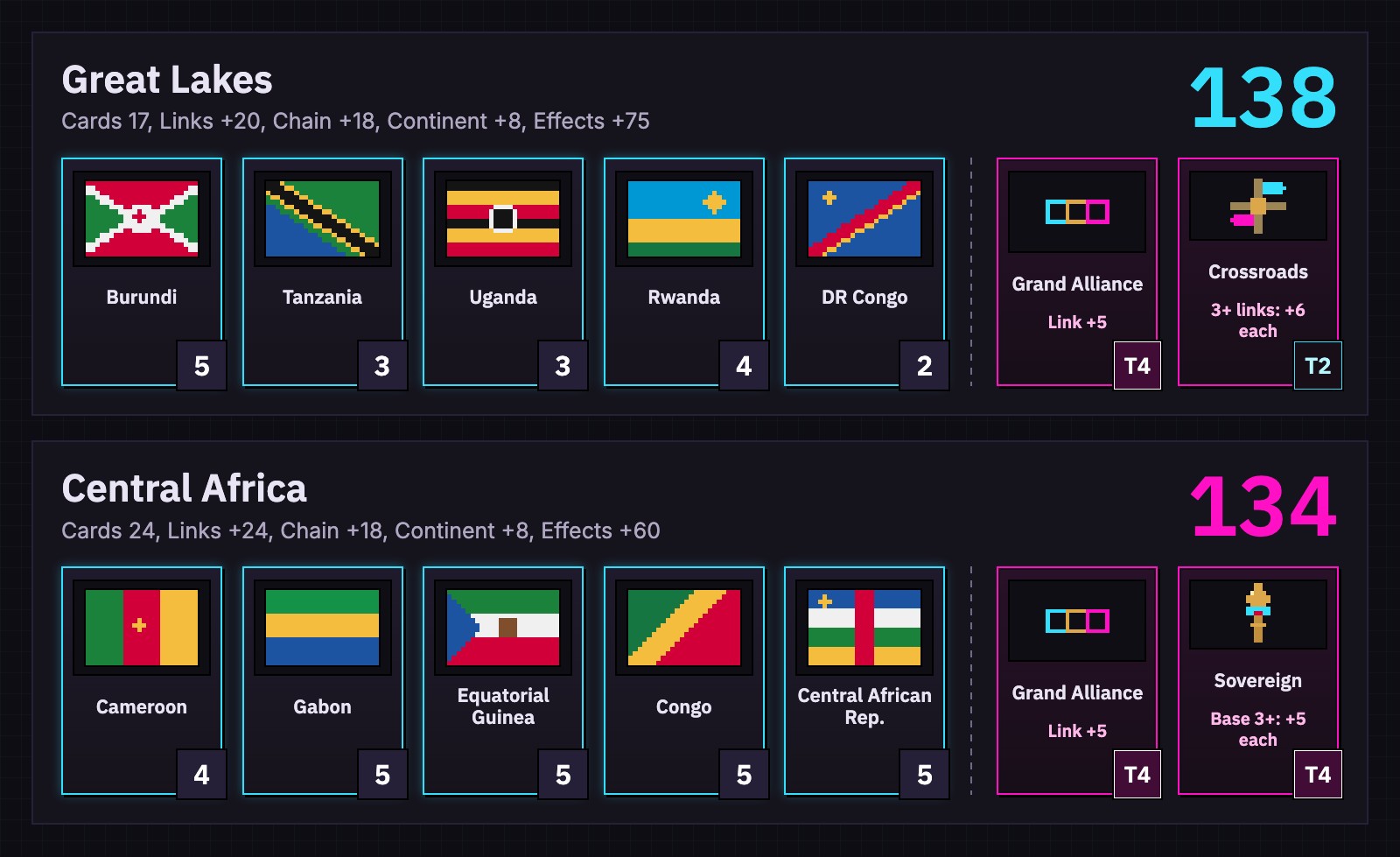
Grand Alliance pays 5 per link, so nine links make it worth 45 here. It is a tier 4 card, which means nothing before round 9, and even then a given shop shows it only about 6% of the time in rounds 9 and 10. Add Crossroads, which pays 6 points for each country linked to 3 or more other countries on your board, and you are at 138. Both cards together add 75 points to a board that was 63.
In our 4,000 bot matches, bots holding Crossroads at the end finished 1.62 on average and bots holding Grand Alliance 1.92, the two best marks of any effect card. Late cards always look good in that kind of count, since only survivors live long enough to hold them, but this pair kept turning up on winners in every region. The talent tier list covers which talent picks help you get there.
Build your giants in the Sahara, not in Russia
Russia, China, Mongolia, Kazakhstan and India are the giants most players reach for first. They are all tier 1, which means they are worth 1 point each. Put them together with Giants (each country over 1 million km² adds 5 points) and Grand Alliance (each link adds 5), and you get 90 points.
Algeria, Chad, Libya, Mali and Niger are not famous. They are tier 3 and 4, worth 3 to 4 points each. They are also all over 1 million km², and they form a connected chain across the Sahara. Giants and Grand Alliance on this board are worth 123 points.
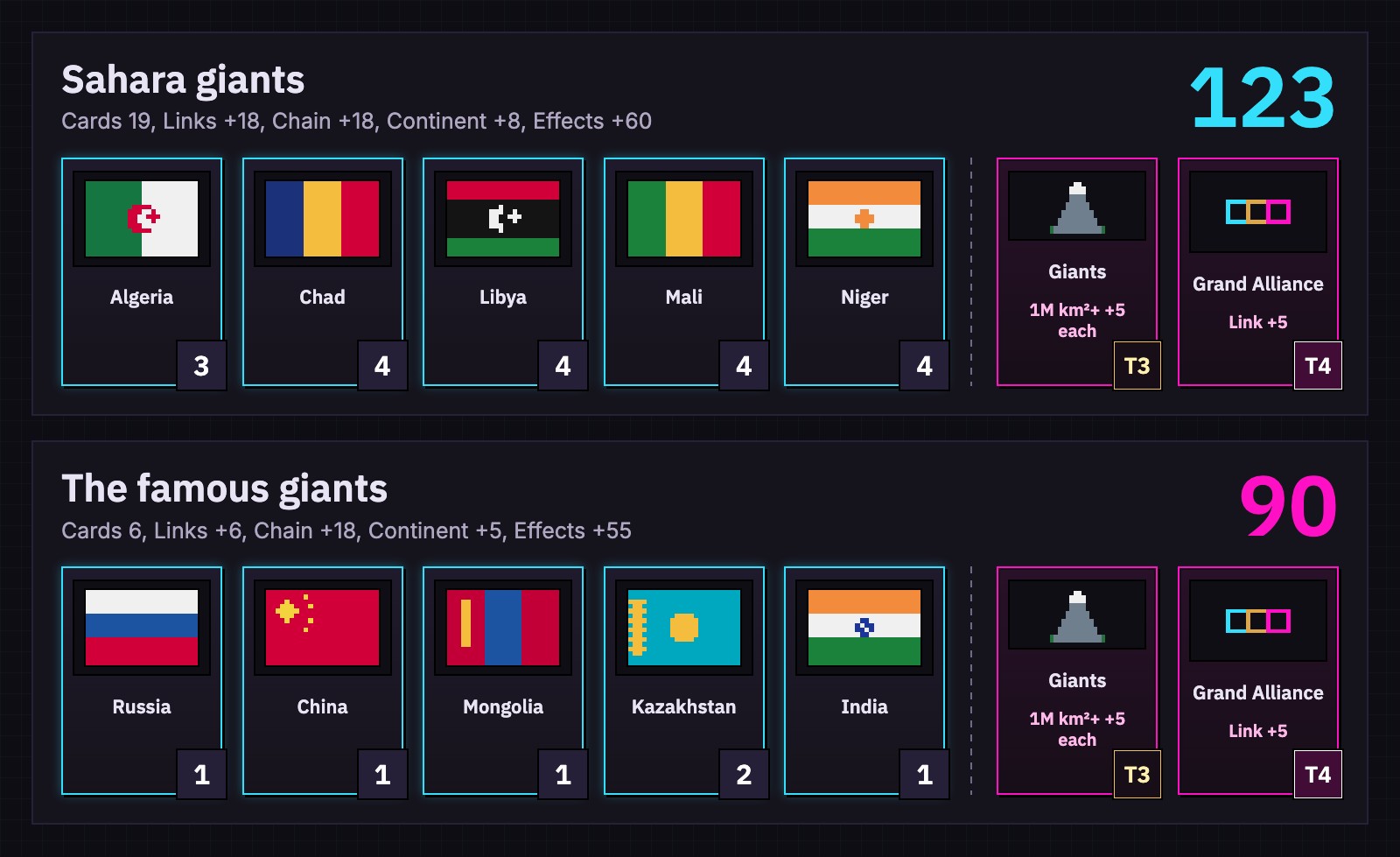
The lesson here is not that you should memorize the Sahara. It is that Giants cares about size, not fame. Heartland, which rewards your largest country by area, only pays its full 17 points if you include Russia. But Giants gives the same 5 points to Algeria as it does to Russia. If you have five big African flags, Giants will probably be better than trying to chase a famous empire.
Skip the islands and scatter southern flags instead
Islands are often weak because they are hard to link. But that does not mean unlinked boards are weak. Botswana, Burundi, Congo, Eswatini and Lesotho have no links to each other, yet all five have capitals south of the equator. Southern Cross pays 4 points for each country with a capital in the southern hemisphere. Add Sovereign, which adds 5 points to each card with base 3 or higher, and you reach 78 points.
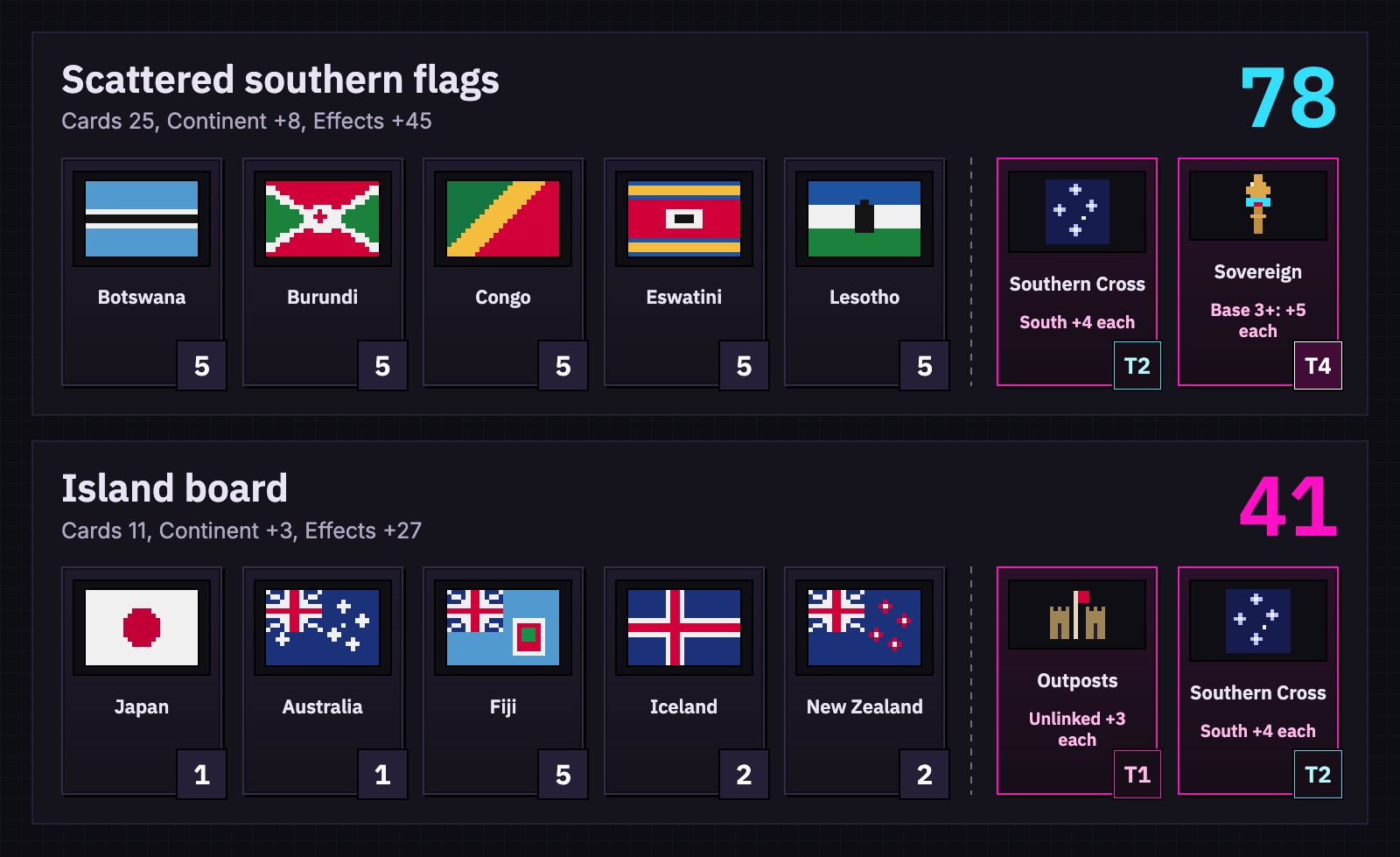
Island countries like Japan, Australia, Fiji, Iceland and New Zealand are mostly tier 1 and 2, which is why they start at only 14 points total. Even with Outposts (3 points per unlinked country) and Southern Cross (4 points per southern capital), they reach 41. Scattered mainland flags in the southern hemisphere beat them. Outposts is efficient early, but it caps out fast. Southern Cross and Sovereign are better long-term partners, especially if your scattered flags include some high base scores.
Count hubs before you pay for Crossroads
Crossroads is deceptive. It sounds like a link card, but it is actually a connectivity card. Each of your countries that is linked to 3 or more other countries on your board gets 6 points. This is different from Grand Alliance, which rewards individual links.
On a five-card board, Crossroads only works if your countries crowd together. A straight line of borders pays nothing, because no country touches three others. On the Central Africa chain three of the five do, so Crossroads pays 18. The Great Lakes board, with nine links among five cards, has all five countries linked to 3 or more others. Crossroads is worth 30 points there. Combine it with Grand Alliance (45 points) and you are already at 138 on a board that bases 63.
Crossroads is underrated because people think of link cards as flat bonuses. It is not. It rewards density. The Baltic countries (Russia, Belarus, Poland, Lithuania, Latvia with 9 links) score 129 with Grand Alliance and Crossroads. Central Africa with Grand Alliance and Sovereign still edges it at 134, because its flags score more on their own.
Put two people on one homeland to double Patron
People (the historical figures) score between 3 and 6 points, and they also add their score again if their homeland is on your board. Qin Shi Huang is worth 6 and his homeland is China, so on a board with China, Qin adds 6 + 6 = 12 points. Build a board around him and his neighbors (China, Tajikistan, Kyrgyzstan, Bhutan) and the board scores 58 before any effect card.
Patron, the T2 effect card, adds 4 points for each person on your board, or 8 if their homeland is on board. With one person like Qin on China, Patron adds 8, bringing you from 58 to 66. But here is where it gets interesting: China is also Zheng He's homeland. If you fit both Qin and Zheng He on the board with China, Tajikistan and Kyrgyzstan, you give up Bhutan to make room. The board scores 55 before effects. With Patron, each of the two people on China gets +8, so Patron adds 16 total, bringing you to 71.
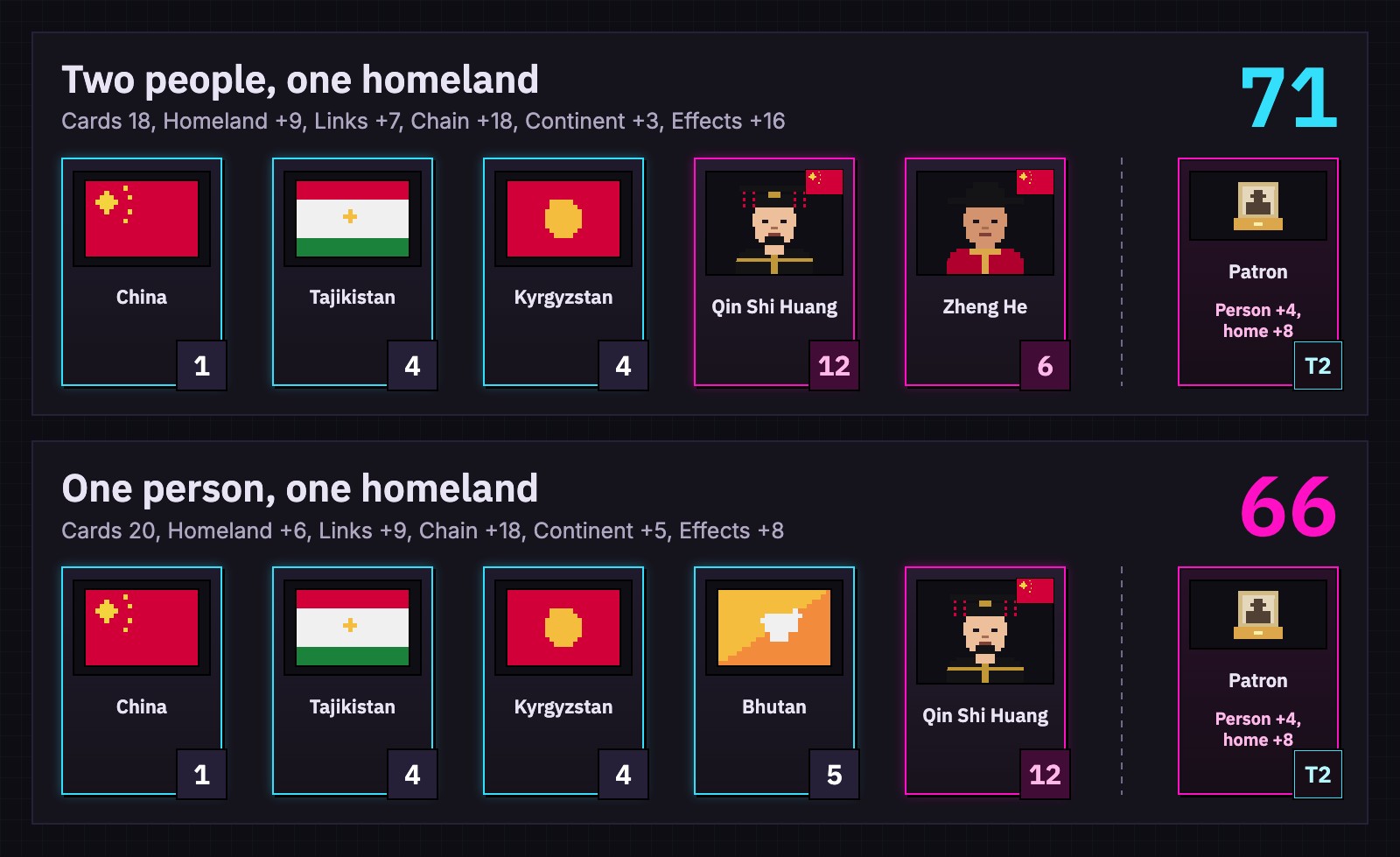
The same homeland trick works for Washington and Lincoln (USA), Magellan and Vasco da Gama (Portugal), and Elizabeth I and Cook (UK). The edge over the one-person board is small, but Patron is a T2 card that shows up in round 3. If you are already building a person board and you see a chance to fit two people on one homeland, Patron becomes one of your best pickups.
Save Sovereign for boards of tier 3 to 5 flags
Sovereign adds 5 points to each of your cards with base score 3 or higher. On a tier-1-only empire (Russia, China, Mongolia, Kazakhstan, India), that is 0 points, because all five are base 1. On a board mixing tier-1 and tier-3 flags, it does better. On the Sahara, which is all tier 3 and 4, Sovereign adds 25 points.
The bot data shows Sovereign finishing in the middle (average 3.24), which is interesting for a T4 card, because T4 cards are rarer than lower tiers. Sovereign works on any board built from tier 3 to 5 flags. Link boards like the Great Lakes benefit less, because links are the main driver. But unlinked or lightly linked boards, or boards mixing high base scores, find Sovereign always useful. It is not flashy, but it is steady.
The best pairs we found still put Grand Alliance next to it. But if you see Sovereign in round 9 and you already have five cards of tier 3 or higher, it is rarely wrong to take it.
Buy for the tier gates you can actually reach
Every effect card has a tier gate. T1 cards (Tide, Edict, Militia, Outposts, Inland, Atlas) start appearing in round 1. T2 cards enter in round 3. T3 cards (Vanguard, Coffers, Rally, Giants) gate at round 6. T4 cards (Grand Alliance, Sovereign, Imperium) do not appear until round 9.
The chance a single shop slot holds an effect card is 18% in round 1, 20% in round 3, 22% in round 6, 24% in round 9, and 26% from round 11. The specific T4 cards are rarer. The chance a 6-slot shop in rounds 9 to 10 shows at least one T4 card is 16%. The chance it shows one specific T4 card (say Grand Alliance) is about 6%.
This means your early plan depends on what the shop can offer yet. The how to play page has the basic shop rules. If you are building a chain, you cannot wait for Vanguard in round 6. You pick up Edict or Iron Crown in round 3, even if they are only 6 to 10 points. If you are building towards Crossroads and Grand Alliance, you need to get to round 9 with a link-dense board intact, because you cannot buy those cards until then.
The one way around the gates is the Grand Bazaar talent, which opens earlier tiers: T2 in round 1, T3 in round 4, T4 in round 7. If you pick Grand Bazaar before round 1, you might see Vanguard in round 4 instead of round 6, or Grand Alliance in round 7 instead of round 9. This is powerful, but it is a single talent slot, so you are trading something else to get there.
Copy the boards that kept winning our bot matches
Some winning boards from our bot matches are worth copying outright. One bot ended on Tajikistan, Kyrgyzstan, Uzbekistan, Afghanistan and China with Grand Alliance and Crossroads, scoring 126 before talents. Another won on Brazil, Argentina, Paraguay, Bolivia and Uruguay with the same two cards, 120. That pair kept showing up on winners across different regions.
A different bot built Belarus, Poland, Lithuania, Russia and Latvia with Grand Alliance and Crossroads for 129, then used the Sixth Seat talent to add Ukraine as a sixth card and reached 160. This is rare, but it shows that link-based boards scale into the late game if you preserve them.
One outlier bot won with no links at all: Rwanda, Central African Rep., Eswatini, Botswana and Niger with Inland and Sovereign, 76 before talents. With the Lone Stars talent (which removes Outposts from the shop), it reached 96. This board worked because Inland pays 4 for each landlocked country, and Sovereign pays 5 for each base-3-or-higher card. Unlinked does not mean weak.