How to become a FlagDecker master
A practical FlagDecker guide to shaping a board, choosing talents and effects with purpose, and spending gold so your nation improves throughout the run.
What a strong nation is doing
A strong FlagDecker board is not just a pile of expensive flags. It has a clear primary plan and a support plan: a connected neighbour chain, a continent set, a rare-flag core, a people-and-homeland package, or an effect-card engine. The best boards usually combine two of those ideas, with one doing most of the scoring and the other covering its weak spots. If you cannot name what your nation is trying to do, every shop decision becomes a guess.
That plan has to survive the table. Six players sit down, the last nation standing wins, and a match can also end after a limited number of rounds, so a board that only pays off later is fragile. Keep improving the board you have while you work toward the board you want. Buy flags that make the current board stronger, not flags that would be great if three other things appeared. The player who wins is usually the one whose purchases keep compounding instead of resetting.
Strong players also treat talents, people, and effects as part of the same plan. A talent should reinforce what your shop and board are already good at. A famous person should match their home country's flag. An effect card should open a play your flags cannot make alone. Gold is the glue: it lets you buy the connector, refresh for the missing piece, or hold for the stronger effect that appears later. None of those tools work if you spend them without a reason.
Build a chain of neighbours
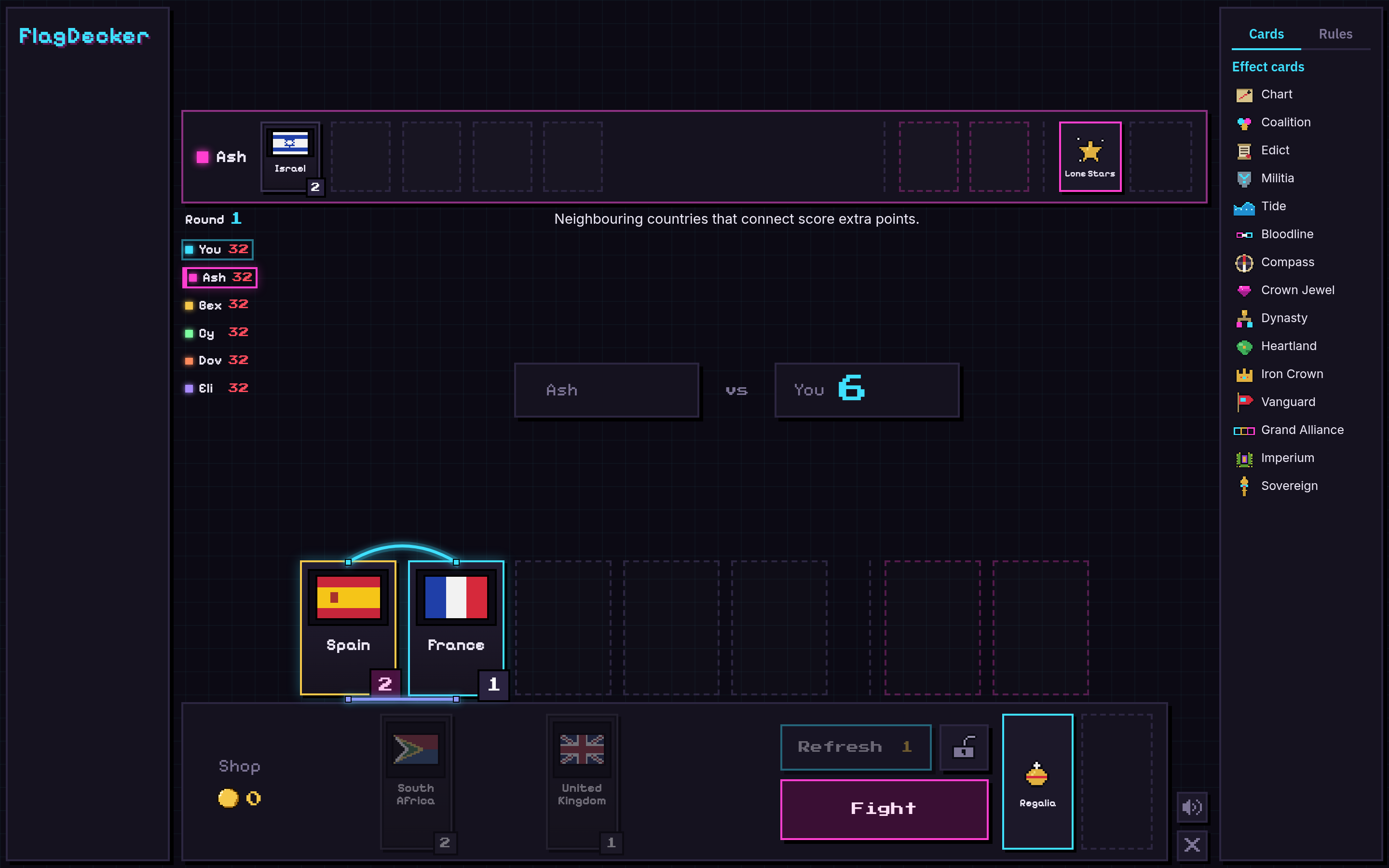
The neighbour chain is the easiest plan to see and the easiest one to break. Neighbouring countries placed so they connect make a chain and score extra, so start by thinking about where a flag can connect before you buy it. A flag that extends your chain is usually better than a slightly rarer flag that sits alone. A flag that joins two small groups can be better still because it turns scattered pieces into one connected board.
When you draft, ask what job the flag does. Does it start a chain, extend a chain, or connect two parts of the board? If the answer is none of those, it needs another reason to be there, such as a continent bonus, a people combo, or a rare-flag core. Selling is part of chain management too: do not sell a connector that holds your board together just because you need gold. Sell the flag that contributes least to the chain, the continent plan, or the core you are protecting.
Do not force a chain when the shop stops supporting it. If you keep seeing flags that do not connect and you are refreshing for one perfect neighbour, you may be better off using the flags you have for a continent bonus or shifting toward effects. A chain should be the backbone of the board, not a trap that keeps you buying cards you cannot place well.
Lean on a continent
Continent builds are the counterweight to chain builds. Flags from the same continent pay a bonus even when they are not sitting together, so a continent plan gives you a way to score without perfect placement. That makes it a strong secondary plan and, in some shops, a primary one. If your chain is not coming together, a set of flags from the same continent can keep your board productive while you wait for better connections.
Pick a continent because the shop is offering it, not because you decided before the first draft. A continent plan needs enough flags to matter, so each non-continent purchase has to justify its place. Rare flags from your chosen continent are especially valuable because they support the continent bonus and stand on their own. People from that continent can also become a package with their home-country flag, but only if you actually have the homeland flag to pair them with.
The best continent boards still care about placement. When a continent flag also fits your neighbour chain, it is doing two jobs at once. When it does not, treat it as a separate scoring layer and keep the chain intact where you can. Watch what rivals are building as well: if the table is crowded on one continent, be ready to move to another plan before your shop support dries up.
Make rarer flags count
Rarer flags are worth more on their own, which makes them tempting. The mistake is buying every rare flag you see and assuming the board will sort itself out. A rare flag is strongest when it anchors a plan: it sits in the middle of a neighbour chain, completes a continent set, or pairs with a famous person from its home country. If it does none of those things, it is an expensive distraction.
Use rarity to decide where to invest, not what to collect. A rare flag can be the core you protect while you build around it, but it still needs support from the rest of the board. Do not sell that core casually just to fund a refresh, and do not break a working chain to place it somewhere it scores alone. At the same time, do not overpay for a rare flag that does not fit. Gold is limited, and a modest connected plan often does more than a scattered pile of expensive flags.
Rarity also affects your timing. If your board is stable, holding gold for a rarer flag or a stronger later effect can be better than spending on marginal upgrades. If your board is falling behind, a rare flag that immediately improves your main plan is worth taking. The question is always the same: does this flag make the nation I already have stronger, or does it start a new plan I cannot support?
Combine talents, people, and effects
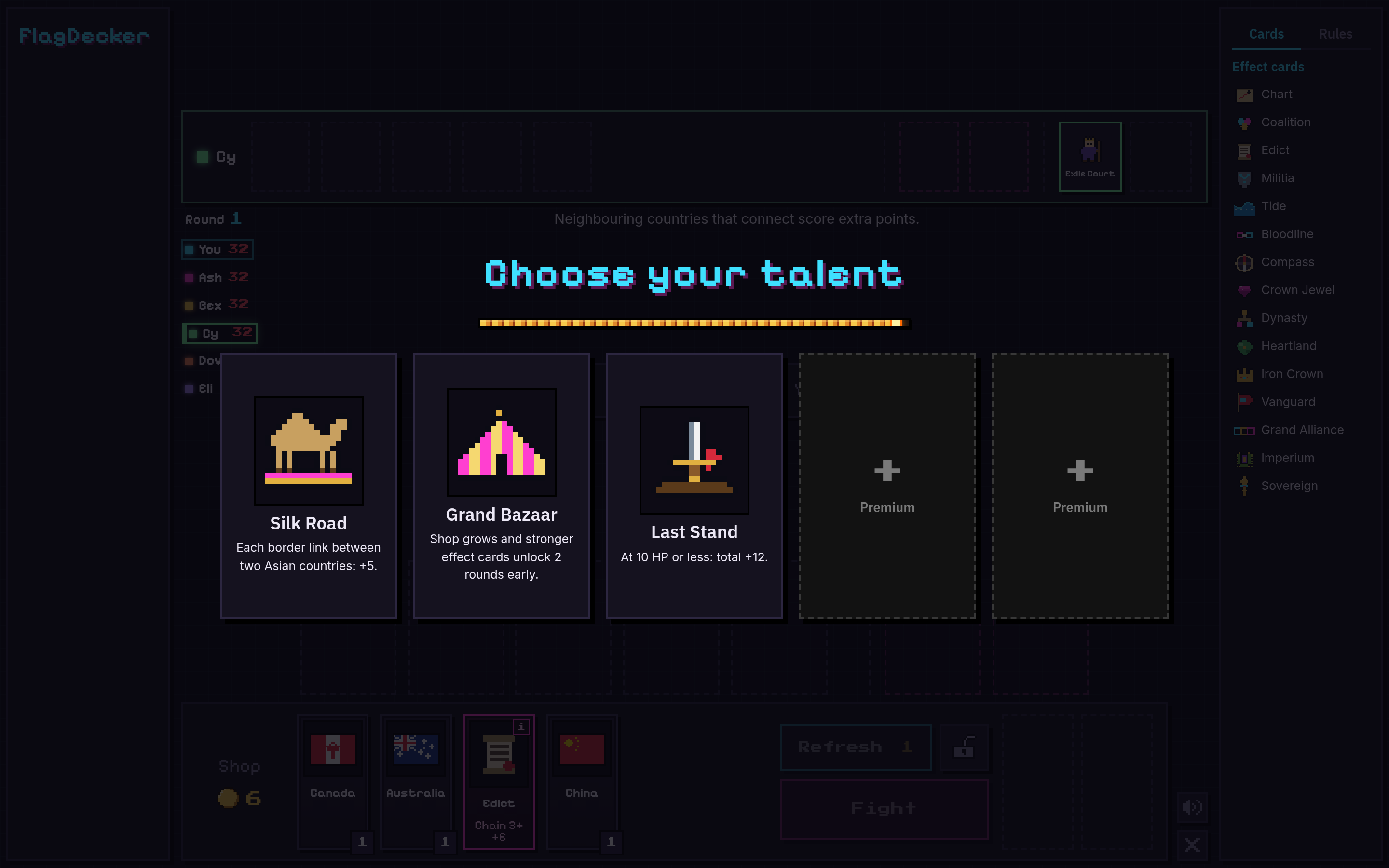
Talents set the direction of a run. You pick one at the start and another later, and every player has access to the same talent pool, so the choice is about fit rather than scarcity. Take a talent that leans into what your board is already doing: continents, neighbour chains, rare-flag cores, or effect-card support. If the first talent points one way and the shop pulls you another, use the later talent to correct the plan instead of forcing the original idea.
Famous people are a targeted combo, not a general upgrade. They combo with their home country's flag, so the pair is what matters. Buy a person when you have the homeland flag or when you are close to completing the pair, and place the pair where it supports your chain or continent plan. A person without the matching flag is usually a dead purchase, and a homeland flag with no person is just a flag unless it is already doing work in your chain or continent set.
Effect cards are where FlagDecker opens plays that flags alone cannot make. They can cover a weak chain, support a continent plan, or make a rare-flag core more consistent, and stronger effects show up later in a run. That gives you a reason to hold gold and a reason to pay attention to the shop beyond raw flag quality. Do not fill your board with effects that do not serve the main plan, but do not ignore them when they solve a problem your flags cannot.
Spend gold with a plan
Gold is limited, refreshing the shop costs gold, and selling a card is sometimes the only way to recover from a bad purchase. That means every refresh should have a purpose. Before you refresh, name the card you are looking for: a neighbour connector, a continent flag, the homeland flag for a person you already have, or an effect that fixes a specific weakness. If you cannot name it, you are probably refreshing on impulse.
Holding gold is a real decision, not a passive one. Stronger effects appear later in the run, and rare flags can define a core, so saving can be correct when your board is stable and the current shop only offers sidegrades. Spending is correct when waiting would leave your board too weak to compete. The skill is in recognizing which situation you are in. If a purchase improves your main plan now, take it; if it only improves a plan you hope to build later, be more careful.
Selling should follow the same logic. Sell the card with the least impact on your chain, continent set, core, or people combo. Do not sell a key connector or a rare core unless you are genuinely pivoting, because the gold you gain can cost you more board strength than it buys. A clean sale that funds a real upgrade is good economy; a panic sale that breaks your board is not.
Adapt as the table changes
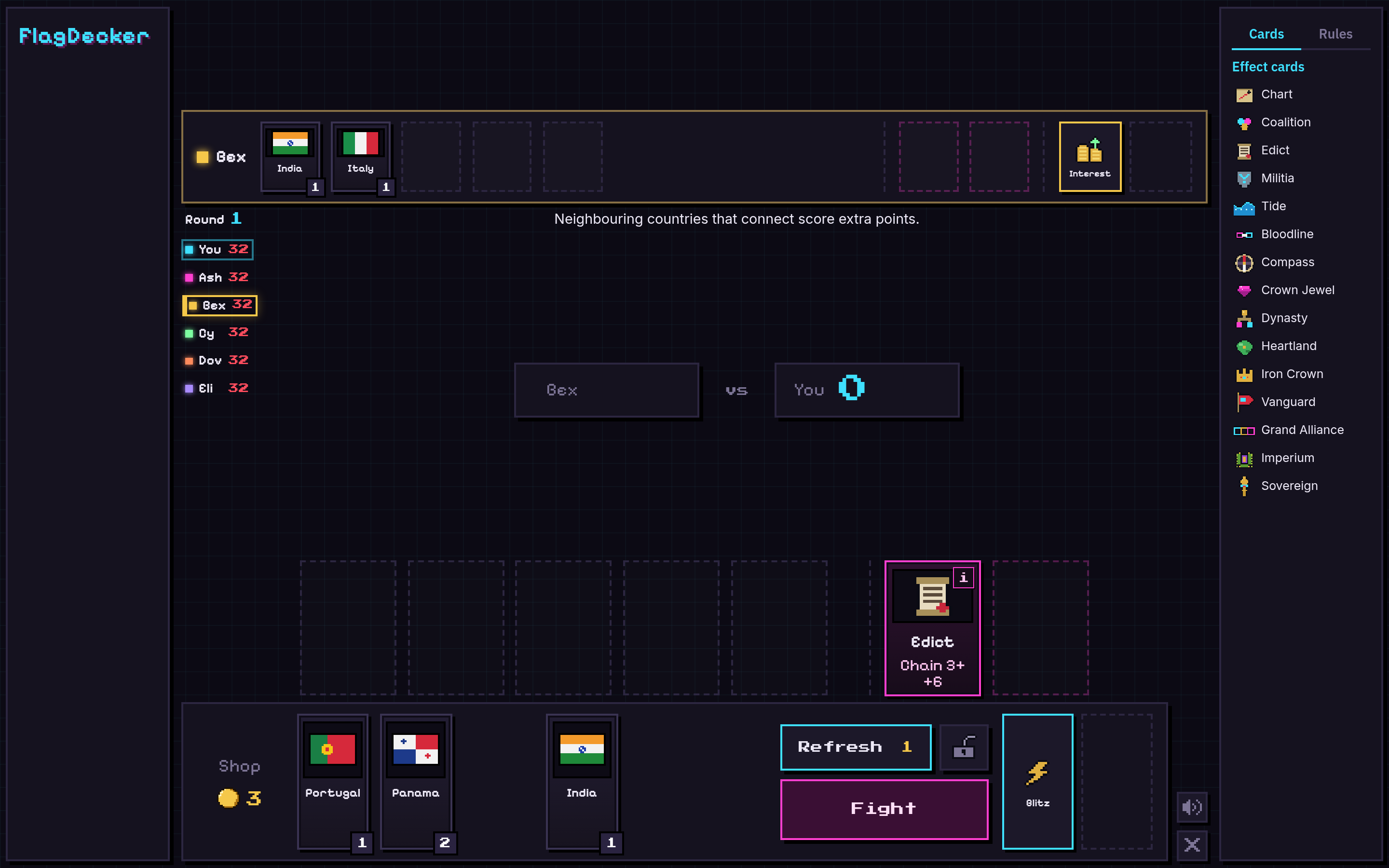
FlagDecker is a six-player game, so your plan is never the only plan at the table. Watch what rivals are building and what the shop is offering. If several players are leaning on the same continent, your support may become harder to find, and a pivot to a neighbour chain, a rare-flag core, or an effect plan can be better than fighting for the same cards. Adaptation does not mean changing your whole board every round; it means knowing which part of your plan is still working and which part needs help.
Use your later talent as a pivot tool. If your first talent pointed toward continents but the shop keeps giving you strong neighbour flags, the later talent can pull the board back toward chains. If you have a rare-flag core but no support, an effect or a people combo can make it function. The important thing is to commit to the board you can actually build, not the board you imagined at the start.
Gold discipline matters most when the table changes. If you are behind, spend to stabilize your main plan rather than saving for a perfect late card. If you are stable, hold gold for the stronger effects and rare flags that can decide the run. Play with Friends is a good place to test those pivot decisions because the pressure is lower, while Ranked will punish a board that never adapts. Versus Bot is useful for practicing the basics of chain placement and shop timing before you take those habits into a competitive match.
A short path to getting better
Improvement comes from practicing one decision at a time. In Versus Bot, pick a single focus for a run: keep a neighbour chain connected, build a continent set, or protect a rare-flag core. Do not try to learn everything at once. When the match ends, look at the board and ask whether each purchase supported the plan you named at the start. That review is more useful than another game played on autopilot.
In Ranked, shift your focus to reading the table. Notice which plans rivals are building, which shops are offering support, and when you are forcing a plan that is no longer there. Practice holding gold when your board is stable and spending when it is not. In Play with Friends, test pivots and unusual combinations: a people-and-homeland package, an effect-heavy board, or a late talent change. The goal is to make those decisions familiar before they matter in a ranked match.
Use this short checklist as a review tool, not a set of rules to follow blindly:
- Can you name your nation's primary plan and its support plan?
- Did every refresh have a specific card in mind?
- Did you sell a card that was still doing real work?
- Did your talent match what the shop and board were actually offering?
- Did you adjust when rivals or the shop changed the shape of the match?
A FlagDecker master is not the player who collects the most rare flags. It is the player who builds a board with a clear job, uses talents and effects to support that job, and spends gold with enough discipline to adapt when the table changes. Keep your chain connected, your continent plan honest, your rare flags supported, and your gold purposeful, and your results will follow.